Whether you’re a new manufacturer or upgrading your notebook production unit, one of the biggest decisions you’ll face is choosing between a manual or an automatic notebook machine. Let’s help you decide which one truly fits your business.
📘 Introduction
Starting a notebook manufacturing business involves several important choices — and perhaps the most crucial among them is the type of machinery you invest in.
Many entrepreneurs begin with manual machines to reduce costs, while others go straight for fully automatic systems to scale faster. But what’s the real difference between the two?
At NotebookMachine.com, a proud subsidiary of Bhartiya Machine Works, we manufacture and supply both manual and automatic notebook machines. We’ve worked with small startups and large-scale factories across India, helping them choose the right setup based on their goals, budgets, and production needs.
This article breaks down the differences between manual and automatic notebook machines, comparing everything from cost and productivity to maintenance and long-term profitability — so you can make a confident, informed decision.
⚙️ What Are Manual and Automatic Notebook Machines?
Before we dive into comparisons, let’s understand what each type actually means.
Manual Notebook Machines
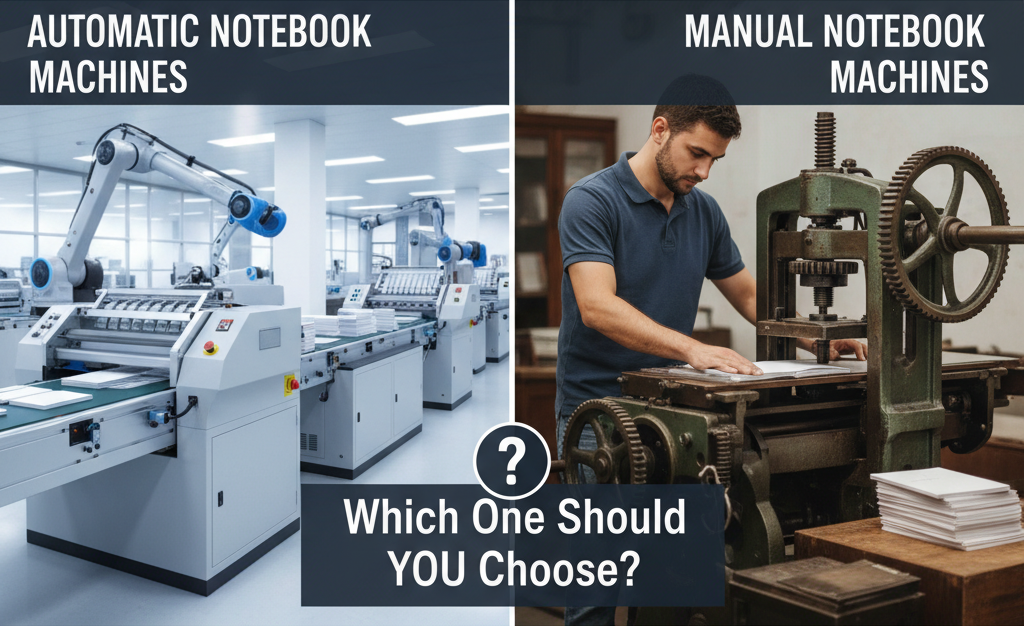
These machines rely primarily on manual labor or semi-mechanical operation. The operator feeds the paper, aligns the covers, and controls most steps manually.
Common examples include:
-
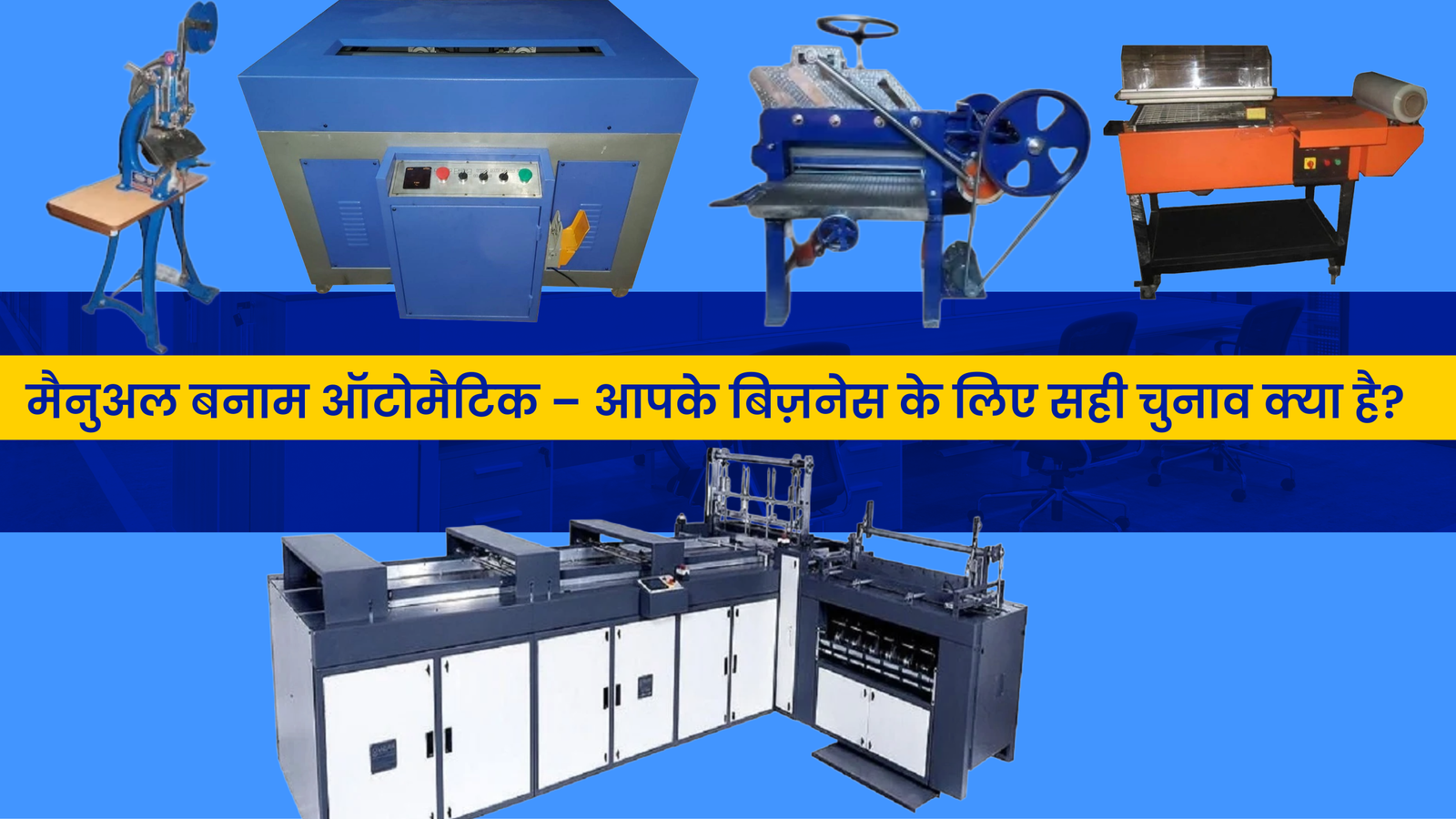
Manual Notebook Cutting Machine
-
Manual Stitching Machine
-
Manual Edge Squaring Machine
-
Manual Spiral Making Machine
They are budget-friendly and perfect for small-scale notebook units or new entrepreneurs.
Automatic Notebook Machines
Automatic notebook machines are powered by electric motors and PLC control systems. They handle multiple stages of production with minimal human intervention — from stitching and folding to cutting and squaring.
Examples include:
-
Sensor-Based Cutting Machine
-
PLC-Controlled 2-in-1 Stitching & Folding Machine
-
Fully Automatic 4-in-1 Notebook Making Machine
Automatic systems are ideal for large-scale production units where speed, precision, and consistency are essential.
⚖️ Manual vs Automatic Machines – Feature Comparison
Here’s a side-by-side comparison of both systems across key factors:
| Feature | Manual Machines | Automatic Machines |
|---|---|---|
| Operation | Human-controlled | PLC/Motorized |
| Speed | 200–500 notebooks/hour | Up to 3,000 notebooks/hour |
| Accuracy | Depends on operator skill | Highly consistent and precise |
| Manpower Requirement | 3–5 operators | 1–2 operators |
| Initial Investment | Low (₹25,000 – ₹3,00,000 per machine) | High (₹4,00,000 – ₹18,00,000 depending on model) |
| Maintenance Cost | Minimal | Moderate |
| Power Consumption | Low | Moderate to High |
| Production Quality | Good for small batches | Excellent and uniform |
| Best For | Startups & Small Units | Medium to Large Factories |
🧩 Advantages of Manual Notebook Machines
Manual notebook machines have stood the test of time and remain a solid choice for small manufacturers.
💰 1. Low Investment
Manual machines are affordable, making them perfect for new entrepreneurs. You can start your notebook production business with minimal financial risk.
For example:
-
Manual Stitching Machine: ₹25,000 – ₹35,000
-
Manual Spiral Machine: ₹20,000 – ₹30,000
-
Manual Cutting Machine: ₹1,25,000 – ₹1,75,000
👉 Explore our Manual Notebook Machines to find the right model for your budget.
🧠 2. Easy to Operate
Manual machines don’t require specialized training or advanced technical knowledge. Anyone can learn to operate them with minimal guidance.
At Bhartiya Machine Works, we even offer basic on-site training with every machine purchase.
⚙️ 3. Low Maintenance
Manual systems have fewer mechanical parts, which means less wear and tear and lower maintenance costs.
You can perform minor servicing yourself, without needing a technician.
📦 4. Flexibility in Production
Manual machines are great if you handle multiple notebook sizes or small custom orders. They allow greater control over small-batch runs and varied designs.
🚀 Advantages of Automatic Notebook Machines
If you’re planning to scale or enter high-volume production, automatic notebook machines are the way to go.
⚡ 1. High-Speed Production
Automatic machines dramatically increase output.
For instance, a Fully Automatic 4-in-1 Notebook Making Machine can produce up to 3,000 notebooks per hour, combining cutting, stitching, folding, and squaring in one system.
👉 Learn more about our Fully Automatic Notebook Machines.
📏 2. Consistent Quality
Since operations are controlled by PLC or sensors, automatic machines deliver highly uniform notebooks with precision in stitching and cutting.
This helps maintain consistent brand quality — vital for bulk orders from schools or corporate clients.
👷 3. Reduced Labor Costs
Automatic machines require only 1–2 operators for supervision and feeding materials, compared to multiple workers in manual setups.
This saves manpower expenses and increases productivity per person.
🔄 4. Time Efficiency
Automatic machines complete multiple processes in one continuous flow. You save valuable production time, allowing faster order completion and better delivery performance.
💼 5. Long-Term Profitability
While the initial investment is higher, automatic machines pay off in the long run through higher output, less wastage, and faster return on investment.
Many of our clients at NotebookMachine.com report recovering costs within 12–18 months after installation.
💸 Cost Comparison: Manual vs Automatic Machines
| Machine Type | Manual Price Range (₹) | Automatic Price Range (₹) |
|---|---|---|
| Cutting Machine | 1,25,000 – 1,75,000 | 2,50,000 – 3,50,000 |
| Stitching Machine | 25,000 – 35,000 | 40,000 – 65,000 |
| Edge Squaring Machine | 1,50,000 – 2,00,000 | 2,25,000 – 2,50,000 |
| Spiral Machine | 20,000 – 30,000 | 45,000 – 60,000 |
| Shrink Packing Machine | 85,000 – 1,00,000 | 1,25,000 – 1,50,000 |
| Fully Automatic 4-in-1 Machine | – | 15,50,000 – 18,00,000 |
Note: Prices are approximate and may vary depending on configuration and customization.
🏭 Which Machine Should You Choose?
Your choice depends on three main factors: budget, production volume, and business goals.
✅ Choose Manual Machines if:
-
You’re starting a small notebook business.
-
You want to test the market first.
-
You have limited investment capital.
-
You prefer simple, easy-to-maintain machinery.
Best For: Startups, local stationery brands, and low-volume units.
⚙️ Choose Automatic Machines if:
-
You already have steady demand or bulk orders.
-
You want faster output and consistent quality.
-
You aim for long-term scalability and brand growth.
-
You want to minimize labor dependency.
Best For: Established manufacturers, school suppliers, and exporters.
🧠 Expert Tip from Bhartiya Machine Works
If you’re just starting out, a hybrid setup can be an excellent middle path.
For example:
-
Use semi-automatic cutting and motorized stitching machines to balance cost and speed.
-
Later, upgrade to a fully automatic 4-in-1 system as your demand increases.
This step-by-step scaling approach reduces risk and builds operational experience.
🏢 Why Buy from NotebookMachine.com
At NotebookMachine.com, we offer the complete range of notebook manufacturing machines, including manual, semi-automatic, and fully automatic models.
Here’s why manufacturers across India choose us:
✅ Backed by Bhartiya Machine Works, trusted for over 25 years
✅ Machines for all budgets and capacities
✅ Custom-built designs for specific notebook sizes
✅ On-site installation and training support
✅ Reliable after-sales service and spare availability
No matter where you are in your notebook business journey — we’ve got the right machine for you.
👉 Visit NotebookMachine.com today to explore our full product range.
🧾 Conclusion
The debate between manual and automatic notebook machines ultimately comes down to your scale, budget, and vision.
-
If you’re a beginner, start with manual or motorized machines to build experience and manage costs.
-
If you’re ready to expand and meet larger orders, invest in automatic systems for speed, precision, and long-term growth.
At NotebookMachine.com, we help you make the right choice — ensuring every machine you buy delivers value, performance, and productivity from day one.
💡 Ready to upgrade or start your notebook manufacturing journey?
Visit 👉 https://notebookmachine.com and get expert guidance today.