How to Start a Notebook Manufacturing Business: Step-by-Step Setup Guide
Step-by-Step-Guide
Thinking of starting your own notebook production unit? Here’s everything you need to know — from planning, machinery, and raw materials to pricing and profits.
📘 Introduction
The notebook manufacturing business is one of the fastest-growing and most profitable small-scale industries in India. With schools, colleges, offices, and custom stationery brands increasing in number every year, the demand for quality notebooks is never-ending.
The best part? Setting up a notebook production unit requires moderate investment, readily available raw materials, and machines that fit every budget — from manual to fully automatic systems.
At NotebookMachine.com (a subsidiary of Bhartiya Machine Works), we’ve helped hundreds of entrepreneurs set up successful notebook manufacturing units across India.
In this step-by-step guide, we’ll explain exactly how to start your own notebook manufacturing business — including the machinery required, production process, investment breakdown, and practical success tips.
🏗️ Step 1: Plan Your Business and Market
Before purchasing machines, take time to understand your target market and define your business model.
Ask yourself:
-
Who will buy your notebooks — schools, wholesalers, or local stationery shops?
-
Will you produce standard-sized notebooks or custom designs?
-
What volume do you expect to sell per month?
Tip: Start small with manual or semi-automatic machines. Once you establish demand, you can scale up to motorized or fully automatic systems.
A clear business plan also helps you estimate your budget, production capacity, and raw material needs.
📦 Step 2: Arrange Raw Materials
The key raw materials used in notebook manufacturing are easily available in the Indian market.
Primary Raw Materials:
-
Paper Reels or Sheets – Used for notebook pages (70 GSM to 80 GSM common).
-
Cover Paper or Board – For front and back covers (250 GSM – 300 GSM).
-
Gluing Material – Used in binding or edge finishing.
-
Spiral or Stitching Wire – Depending on binding type.
-
Shrink Film – For packaging notebooks.
You can source paper and cover sheets from local paper mills or wholesale markets in cities like Delhi, Mumbai, Ahmedabad, and Coimbatore.
⚙️ Step 3: Select the Right Machines
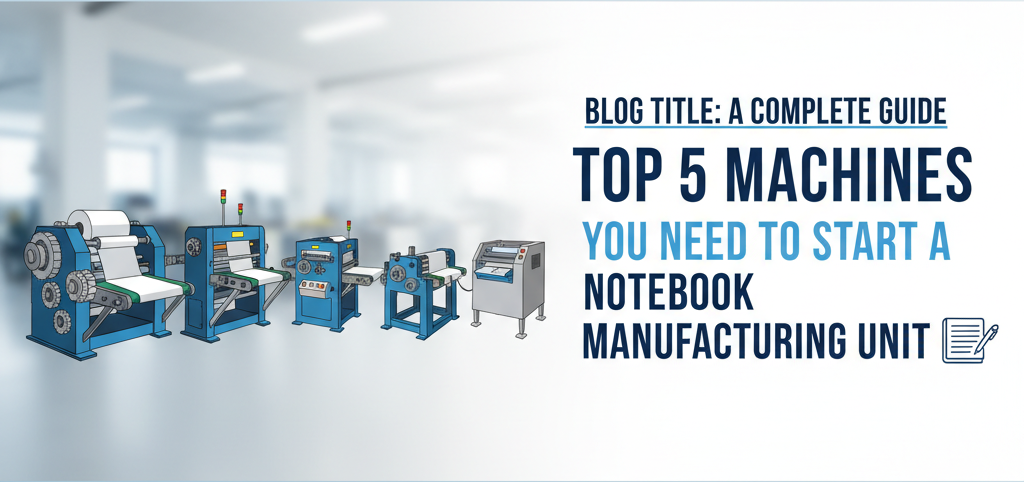
Your machinery choice defines your production quality and output. Here’s what you’ll need to get started:
✂️ 1. Notebook Cutting Machine
This is your first essential machine. It cuts large paper sheets into the required notebook size — such as A4, A5, or custom dimensions.
Available Options:
-
Manual Cutting Machine (budget-friendly)
-
Semi-Automatic Cutting Machine
-
Sensor-Based Automatic Cutting Machine
Sizes: 81 cm and 85 cm (customizable)
Price Range: ₹1,25,000 – ₹3,50,000
👉 Check Notebook Cutting Machines at NotebookMachine.com
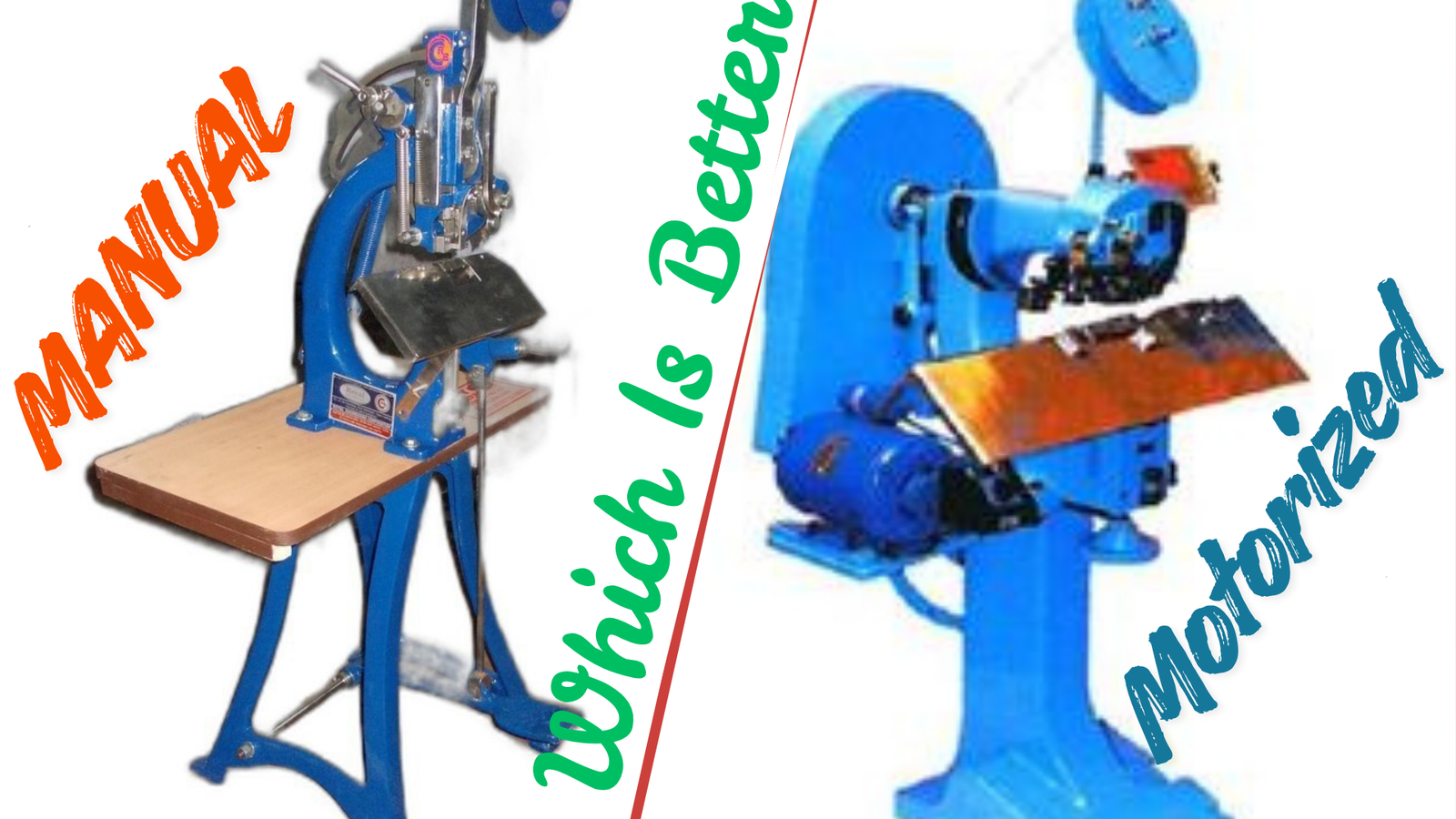
🧵 2. Notebook Stitching Machine
Used to bind the cut sheets into a notebook.
Available in manual and motorized models, depending on production volume.
Manual Stitching Machine: Ideal for small units (₹25,000 – ₹35,000)
Motorized Stitching Machine: High-speed and reliable for large batches (₹40,000 – ₹65,000)
👉 Explore Notebook Stitching Machines
📚 3. Edge Squaring Machine
This machine shapes and finishes the notebook edges perfectly after stitching, giving them a clean, professional look.
Sizes: 81 cm and 85 cm
Price Range: ₹1,50,000 – ₹2,25,000
👉 Browse Edge Squaring Machines
🔄 4. Spiral Making Machine
If you plan to make spiral or wiro notebooks, you’ll need this machine. It handles both punching and spiral binding operations.
Variants:
-
Manual Spiral Machine (₹20,000 – ₹30,000)
-
Motorized Spiral Machine (₹45,000 – ₹60,000)
👉 See Spiral Making Machines
📦 5. Shrink Packing Machine
Used to wrap and seal notebooks for retail. This improves shelf life and product appeal.
Features:
-
Adjustable heat control
-
Conveyor system
-
Compatible with PVC and POF films
Price Range: ₹85,000 – ₹1,50,000
👉 View Shrink Packing Machines
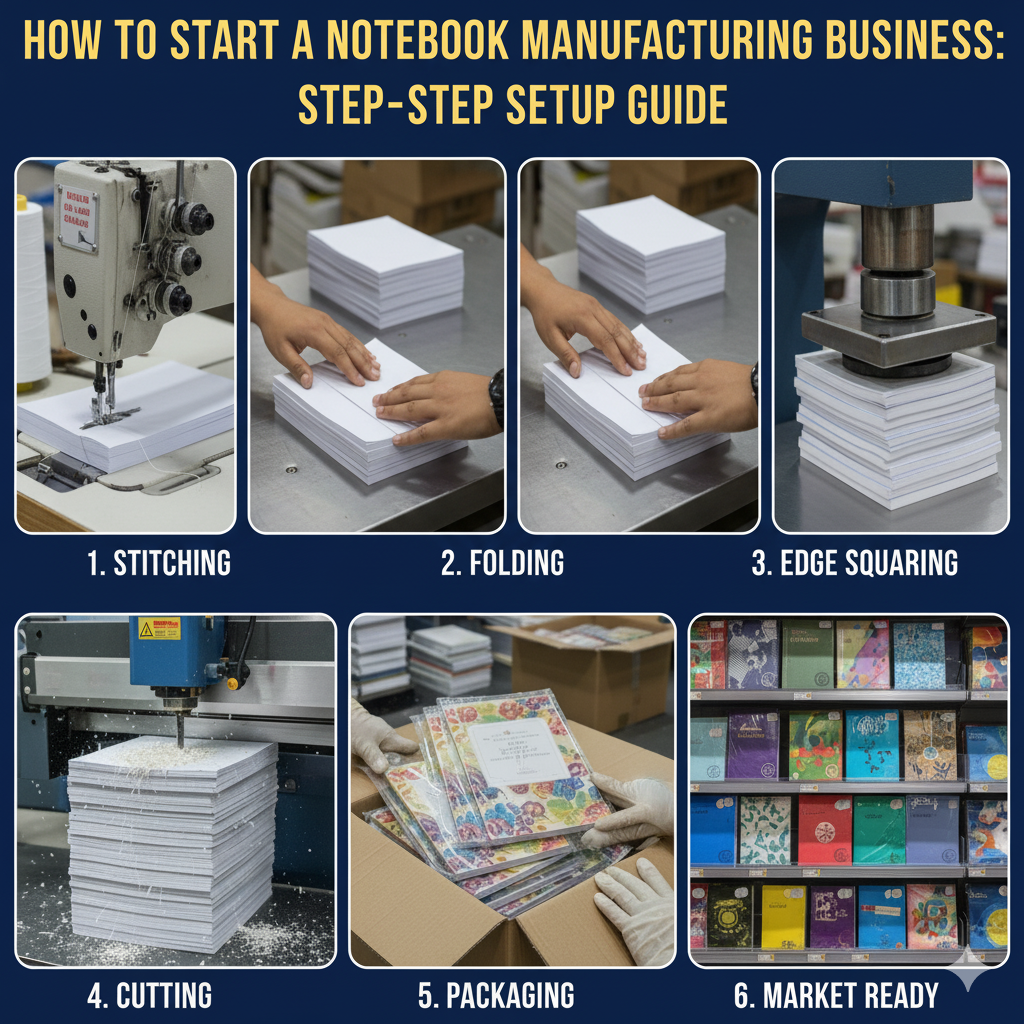
⚙️ Optional Upgrade: Fully Automatic Notebook Making Machine (4-in-1)
For high-volume production, consider a single automated machine that performs:
-
Stitching
-
Folding
-
Squaring
-
Cutting
Production Capacity: Up to 3,000 notebooks/hour
Price Range: ₹15,50,000 – ₹18,00,000
👉 Check Fully Automatic Notebook Machines
🏭 Step 4: Set Up the Factory Space
For a small-scale notebook unit, you’ll need around 1,000 to 1,500 sq. ft. of covered space.
Factory Layout Tip:
-
Cutting Section
-
Stitching Section
-
Squaring & Finishing Section
-
Packaging & Storage Area
Ensure proper ventilation, lighting, and electrical connections for machines.
💰 Step 5: Estimate Investment and Profit
Here’s a simple cost breakdown (approximate for small-scale setup):
| Item | Estimated Cost (₹) |
|---|---|
| Machinery Setup | 4,00,000 – 7,00,000 |
| Raw Material (Initial Stock) | 1,50,000 – 2,00,000 |
| Rent & Setup | 50,000 – 1,00,000 |
| Labor & Utilities | 25,000 – 40,000 per month |
| Packaging & Marketing | 25,000 |
Total Investment: ₹6,00,000 – ₹10,00,000
Expected Profit Margin: 15% – 25% depending on scale and quality.
With efficient machines and good demand, you can achieve break-even within 6–8 months.
🧠 Step 6: Understand the Production Process
Here’s how notebooks are made — step by step:
-
Cutting: Large paper reels are cut into sheets of the desired size.
-
Stitching/Binding: Sheets are stitched or spiral-bound together.
-
Edge Squaring: Finishes the sides neatly.
-
Cover Attachment: Printed covers are added.
-
Pressing & Trimming: Ensures all notebooks are even and aligned.
-
Shrink Packaging: Protects notebooks for transport and sale.
Each step contributes to the final product’s quality and appeal.
📊 Step 7: Get the Required Licenses
For small notebook units, you’ll need:
-
Udyam/MSME Registration
-
GST Registration
-
Local Trade License
-
Electricity Load Approval
Optional but beneficial: Trademark Registration for your brand name.
💡 Step 8: Marketing and Distribution
To succeed, focus on consistent supply and branding.
Marketing Ideas:
-
Supply to schools, coaching centers, and office suppliers.
-
Partner with local stationery shops and book distributors.
-
Offer customization — branded notebooks for businesses or institutions.
-
Create an online presence (e.g., on Indiamart, TradeIndia, Justdial).
At NotebookMachine.com, we often help new manufacturers identify machine configurations and vendor networks for smooth startup.
🏭 Why Choose NotebookMachine.com (Bhartiya Machine Works)
-
✔️ India’s trusted manufacturer of notebook-making machines
-
✔️ Over two decades of engineering expertise
-
✔️ Machines available in manual, motorized, and automatic models
-
✔️ Customization for different sizes and production scales
-
✔️ On-site installation and operator training
-
✔️ Reliable after-sales support and spare part availability
Whether you’re starting from scratch or expanding your production line, we have the perfect setup solution for your business.
✅ Conclusion
Starting a notebook manufacturing business in India is a smart move — offering stable demand, scalable investment, and long-term growth potential.
By choosing the right cutting, stitching, squaring, spiral, and packaging machines, you can efficiently produce premium notebooks ready for the market.
At NotebookMachine.com (powered by Bhartiya Machine Works), we’re here to make that journey smooth and profitable — from the first machine to your full production line.